 01- 4579685/ 4583902/ 4578471/ 4591485
 support@ica.edu.np
 9818505224
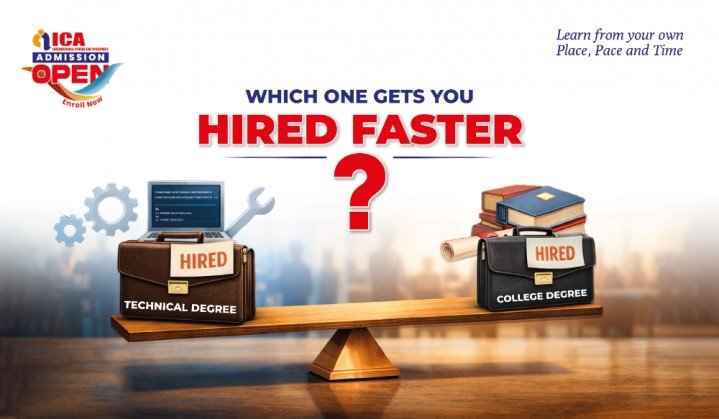
Technical Skills or College Degree: Which Gets You Hired Faster?
The debate is as old as the modern workforce itself. On one side, you have the traditionalists who swear by the four-year university experience as a necessary rite of passage. On the other, a growing legion of pragmatists argues that specific, teachable abilities—technical skills—are the only currency that matters in the job market.
It is a confusing time to be a job seeker. Major corporations like Google, Apple, and IBM have made headlines by removing degree requirements for certain positions, fueling the narrative that the diploma is dying. Yet, data consistently shows that degree holders still earn significantly more over their lifetimes than those without.
So, where does that leave you? If you need a job now, should you enroll in a bootcamp to learn Python, or commit to a multi-year degree program? The answer isn't black and white. While university education provides an unshakeable foundation for long-term career growth, possessing sharp technical skills is often the fastest ticket to an immediate paycheck.
This guide explores the nuances of this debate, helping you decide which path—or perhaps which combination of paths—will get you where you want to go.
The Enduring Value of a College Degree
Despite the noise surrounding "skills-based hiring," the university degree remains a powerful signal to employers. It represents more than just the sum of the classes you took; it demonstrates persistence, the ability to navigate complex systems, and a baseline of intellectual maturity.
Building a Foundation for Life
A college education offers benefits that a six-week coding bootcamp simply cannot replicate. First, there is the depth of theoretical knowledge. Understanding the why behind a concept, rather than just the how, allows you to adapt when technology inevitably changes. Critical thinking, problem-solving, and communication skills are honed over years of study, creating a well-rounded professional who can lead teams, not just execute tasks.
Furthermore, the networking opportunities provided by a university are invaluable. The peers you study with today are the managers and CEOs of tomorrow. Access to alumni networks, professors, and campus events opens doors that might otherwise remain closed.
A Model of Excellence: The International Center for Academics (ICA)
Not all degrees require you to put your life on hold for four years. The International Center for Academics (ICA) in Nepal proves that higher education can be both prestigious and flexible. Established in 1997, ICA has pioneered Open and Distance Learning (ODL), allowing students to balance their education with work—effectively letting them earn a degree and build technical skills simultaneously.
The institution has a storied history of excellence. It was Nepal's first Partner Institution of Indira Gandhi National Open University (IGNOU) in 2002 and has been recognized repeatedly for its quality. ICA was named the "Best Overseas Partner Institution" by IGNOU in 2011, 2013, and 2014, and the "Best Distance Education B-School of Nepal" in 2013.
Crucially, the degrees offered at ICA hold weight. They are approved by Nepal's Ministry of Education, Science and Technology (MOEST) and recognized by Tribhuvan University (TU). This accreditation ensures that graduates are eligible for government jobs, corporate roles, and further studies internationally.
Real-World Success
The proof of a degree's value lies in its alumni. ICA has seen over 8,000 learners complete various levels of education, from undergraduate to postgraduate programs. The institution's commitment to quality is evident in the accolades its students receive.
For example, the prestigious Nepal Bidhya Bhushan Award was bestowed upon Mr. Gagan Gurung (2011), Ms. Kirtan Shrestha (2016), and Ms. Chahana Singh (2019). Additionally, twelve learners have secured IGNOU Gold Medals in diverse fields like Management, Tourism Studies, and Computer Science. These achievements highlight that a flexible, distance-learning degree does not compromise on academic rigor or recognition.
The Power of Technical Skills
While a degree plays the long game, technical skills play the fast game. In an economy driven by rapid technological change, employers often have immediate problems that need solving. If you have the specific skill set to solve those problems, you can often bypass traditional gatekeepers.
Why Skills Speed Up Hiring
Technical skills are practical, specific abilities required to perform a job. In the current market, "hard skills" are often what get your résumé past the Applicant Tracking System (ATS).
When a company needs a website built, they need someone who knows HTML, CSS, and JavaScript. They might care less about your philosophy minor and more about your GitHub portfolio. This demand for immediate utility is why skilled tradespeople and tech workers often find employment much faster than generalists.
High-Demand Skills That Open Doors
Certain skills are currently in such high demand that possessing them acts as a fast-track to employment:
- Data Analysis: The ability to interpret complex data using SQL, Python, or Excel.
- Digital Marketing: SEO, SEM, and social media management are critical for every modern business.
- Software Development: Coding remains one of the most bankable skills in the global economy.
- Cloud Computing: Managing services on platforms like AWS or Azure.
Statistics across various industries show a widening gap between the jobs available and the skilled workers to fill them. This "skills gap" means that if you possess the right technical certification or portfolio, you become a hot commodity instantly.
Balancing Both: The Ideal Scenario
The "degree vs. skills" debate often presents a false dichotomy. You do not have to choose one or the other. In fact, the most employable candidates are those who possess both a recognized degree and relevant technical skills.
The Hybrid Advantage
Combining a college education with technical training creates a powerful professional profile. The degree provides the "soft skills"—leadership, writing, critical analysis—that help you get promoted. The technical skills get your foot in the door and help you execute your daily responsibilities.
This is where institutions like ICA shine. Their motto, "Study from your Place, Pace, and Time," is designed for the modern learner who might already be working. By adopting a blended mode of delivery, including online classes and flexible support, ICA allows students to work full-time jobs where they learn technical skills, all while pursuing their degree.
Why This Combination Works
- Future-Proofing: Technologies become obsolete. The specific coding language you learn today might be useless in ten years. A degree teaches you how to learn, ensuring you can adapt when the market shifts.
- Practical Application: When you work while studying (a possibility with flexible programs like those at ICA), you can apply theoretical knowledge immediately in a practical setting. You might learn about marketing management in class and apply it to a digital campaign at work the next day.
- Credentialing: You satisfy the HR requirement for a bachelor's degree while impressing the hiring manager with your technical portfolio.
Making the Right Choice for Your Career
The question of whether a technical skill or a college degree gets you hired faster depends on your definition of "hired." If you want a specific, task-oriented job immediately, technical skills are your accelerator. If you want a career with a higher ceiling for management and long-term earnings, the degree is your foundation.
However, the smartest route is to stop viewing them as competitors. In a world that values both deep knowledge and practical ability, the winning strategy is to integrate them.
College like the International Center for Academics offer a blueprint for this balance. With government approval, diverse programs, and a flexible structure that respects your time, they allow you to build your academic credentials without pausing your professional growth. Whether you are chasing a gold medal in academics or a promotion at work, the combination of a degree and technical skills is the ultimate career accelerator.
